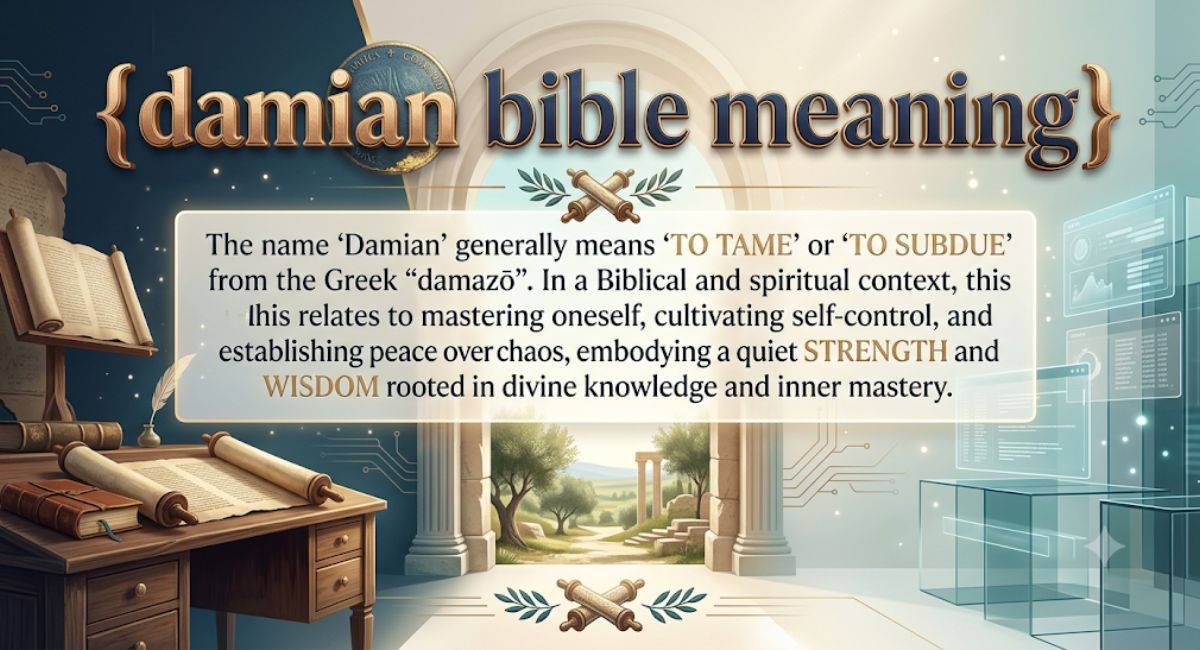

Damian meaning in Bible points to one of Scripture’s most profound and recurring themes — the divine call to tame the self, subdue the flesh, and serve others with healing hands. The name Damian doesn’t appear by name anywhere in the biblical text, and that’s worth saying plainly right from the start. But what the name carries in its very roots speaks a language that Scripture uses on nearly every page — the language of strength under God’s authority, discipline in the Spirit, and compassion poured out freely.
If you’re a parent weighing this name for your child, a believer curious about what God might be saying through it, or simply someone who woke up thinking about Damian and wanted a deeper answer than a name dictionary can give — you’re asking exactly the right question. Names carry weight. They speak over lives. And when you hold Damian up to the light of Scripture, what reflects back is genuinely beautiful. Let’s walk through every spiritual layer together.
Does Damian Appear in the Bible? The Clear, Honest Answer
Damian does not appear anywhere in the Bible. No character in Scripture carries this name. That’s the truthful starting point, and it deserves clarity before anything else. But here’s what matters just as deeply: the absence of a name from Scripture doesn’t limit its spiritual significance one bit.
The Christian tradition has always embraced names from Greek, Celtic, Latin, Germanic, and African roots — languages and cultures that surrounded the early church without being part of the Hebrew biblical canon. What determines whether a name carries genuine spiritual meaning isn’t whether it appears in chapter and verse. It’s whether the meaning of the name aligns with the character and promises of God. For Damian, that alignment is remarkably strong — and it flows directly from the name’s Greek roots through early Christian history all the way into the New Testament themes you already know and love.
| Name | Appears in Bible? | Christian Standing |
|---|---|---|
| Damian | No | Strong Greek-Christian spiritual roots |
| Christopher | No | Universally beloved Christian name |
| Monica | No | Saint Monica — mother of Augustine |
| Sebastian | No | Early Christian martyr |
| Cosmas | No | Paired saint with Damian historically |
| David | Yes | King, psalmist, man after God’s heart |
| Daniel | Yes | Prophet of wisdom and courage |
Damian Name Origin — The Greek Root That Opens Everything
Understanding Damian meaning in Bible starts with understanding where the name actually comes from. The name Damian comes from the Greek word “Damianos,” which is linked to “damao,” meaning to tame, to subdue, or to bring under control. That’s not a passive or gentle meaning. It’s a word loaded with intentional force — the idea of bringing something wild, disordered, or untamed into a state of purposeful control.
In ancient Greek culture, damao described the breaking of a horse — not to break its spirit cruelly, but to channel its raw power into something disciplined and useful. The name Damien generally means “to tame,” “subdue,” or “conquer.” It is derived from the Greek name Damianos, which comes from the Greek word damao, meaning “to control” or “to overcome.” This meaning gives the name a strong and determined character. It reflects someone who has inner strength, discipline, and the ability to overcome challenges. When you carry that meaning into a biblical framework, something extraordinary happens — because the New Testament has an enormous amount to say about exactly that kind of inner discipline and Spirit-led self-mastery.
| Root | Language | Meaning | Era |
|---|---|---|---|
| Damao | Ancient Greek | To tame, to subdue | Classical period |
| Damianos | Greek | One who tames / subdues | Hellenistic period |
| Damianus | Latin | Same meaning, Latinized | Early Christian era |
| Damian / Damien | English/French | Modern forms of the same name | Medieval to present |
Damian Meaning in Bible Through Spiritual Self-Discipline
The most direct biblical connection for Damian meaning in Bible runs straight through the New Testament’s teaching on self-control and spiritual discipline — and it’s more powerful than most people realize. While Damian is not mentioned word-for-word in the Bible, its meaning aligns closely with biblical themes of spiritual discipline, humility, and surrender to God. In Scripture, the idea of taming or subduing is not about power over others. It’s about something far more demanding and far more glorious — mastering the inner life through faith and obedience to God.
Paul writes in 1 Corinthians 9:27 with unmistakable clarity: “I discipline my body and keep it under control, lest after preaching to others I myself should be disqualified.” Here, the meaning of Damian connects strongly to Christian growth. It symbolizes a believer who is being shaped by God — someone learning to walk by the Spirit, not by impulse. That’s the Damian calling distilled into a single verse. And it doesn’t stand alone.
Bible verses that reflect the spiritual meaning of Damian:
“1 Corinthians 9:27 — I discipline my body and keep it under control, lest after preaching to others I myself should be disqualified.”
“Galatians 5:22–23 — The fruit of the Spirit is love, joy, peace, patience, kindness, goodness, faithfulness, gentleness, self-control; against such things there is no law.”
“Proverbs 16:32 — Better a patient person than a warrior, one with self-control than one who takes a city.”
“2 Timothy 1:7 — For the Spirit God gave us does not make us timid, but gives us power, love, and self-discipline.”
“Romans 8:13 — If by the Spirit you put to death the deeds of the body, you will live.”
“Titus 2:11–12 — The grace of God teaches us to say no to ungodliness and worldly passions, and to live self-controlled, upright, and godly lives.”
“James 1:19–20 — Everyone should be quick to listen, slow to speak, and slow to become angry, because human anger does not produce the righteousness that God desires.”
Damian and the Biblical Theme of Healing
Here’s where Damian’s spiritual story deepens considerably — because the name doesn’t only connect to discipline. It connects just as powerfully to healing. The name Damian holds profound significance within the biblical context, representing divine healing and unwavering strength. Derived from the Greek word “Damianos,” it embodies the essence of restoration and resilience, illustrating God’s capacity to mend both physical maladies and spiritual wounds.
This healing dimension flows directly from one of the most revered Christian saints connected to the name. Historically, Saint Damian was known as a healer who served others without payment. While not a biblical figure, his story reflects Christ’s command: “Heal the sick… freely you have received; freely give” — Matthew 10:8. Saint Damian and his twin brother Cosmas were physicians in third-century Syria who treated the poor and the sick completely free of charge, accepting no payment — a practice they called anargyroi in Greek, meaning “the silverless ones.” Their entire ministry echoed the very heartbeat of Jesus’s earthly mission.
Throughout scripture, the theme of healing is prevalent, underscoring the transformative power of faith and divine intervention. When you connect Damian’s Greek root to the healing legacy of the saint who carried it most famously, you get a name that speaks both of strength that subdues and love that restores — two qualities that Jesus himself embodied completely.
| Biblical Healing Theme | Scripture | Damian Connection |
|---|---|---|
| Jesus heals the sick freely | Matthew 10:8 | Saint Damian healed without payment |
| God as Healer | Exodus 15:26 | “I am the Lord who heals you” |
| Compassionate service | Luke 10:33–34 | The Good Samaritan’s healing action |
| Healing through faith | James 5:14–15 | Prayer and anointing for the sick |
| Restoration of the broken | Isaiah 61:1 | Binding up the brokenhearted |
Damian Meaning in Bible — The Hebrew Spiritual Connection
Damian has no direct Hebrew etymology. The name Damien carries a rich Greek heritage but has no Hebrew origins. Many people search for Hebrew meanings because they assume all traditional names come from the Bible. However, Damien stands apart as a purely Greek name. That’s the accurate historical truth. But here’s what makes this spiritually interesting: Hebrew biblical concepts map onto the meaning of Damian with striking clarity, even without a linguistic bridge.
In Hebrew, qualities often linked with the name include strength and resilience, reflecting the concept of being a gibor, or a warrior. This aligns with the broader biblical ideals of leadership and the courage to overcome challenges. The Hebrew word gibor (גִּבּוֹר) means mighty one or champion — and it’s the very word used in Psalm 24:8 to describe God himself: “The Lord, mighty in battle.” A name rooted in taming and subduing carries the same DNA as gibor — power directed with purpose, strength filtered through wisdom.
Two other Hebrew concepts illuminate the Damian journey beautifully. Rapha (רָפָא) means to heal or restore — the root of one of God’s own names, Jehovah Rapha, meaning “the Lord who heals.” And koach (כֹּחַ) means strength, capacity, and ability — the inner resource God pours into those He calls to serve. A name that means to tame and to heal sits comfortably between koach and rapha — between the strength of a warrior and the gentleness of a healer.
Saint Damian — The Historical Figure Who Shaped This Name’s Christian Identity
No exploration of Damian meaning in Bible would be complete without understanding the saint who gave this name its most enduring Christian identity. Saint Damian — known historically alongside his twin brother Saint Cosmas — was an early Christian martyr and physician who lived in third-century Syria. Together they practiced medicine as a form of Christian ministry, refusing all payment from their patients as a deliberate act of Christlike generosity and radical service.
Their refusal of payment wasn’t simply generous — it was theological. They believed that the gift of healing came from God, and what came from God freely should be given to others freely. This mirrors Jesus’s words in Matthew 10:8 almost exactly: “Freely you have received; freely give.” Their witness spread rapidly through the early church, and they were martyred together during the Diocletianic persecution around 303 AD. The Catholic Church, the Eastern Orthodox Church, and many Protestant traditions all venerate them as models of faith-driven service.
The symbolism of Damien goes beyond healing, representing sacrifice and strength. This name carries hidden power, invoking divine protection and transformation, making it a powerful symbol in both biblical and spiritual contexts.
What the life of Saint Damian teaches about the name’s spiritual calling:
“He gave away what most people would charge for — a radical act of trust that God would provide everything needed.”
“His partnership with his twin Cosmas reflects the biblical truth that we are not called to serve alone but in community.”
“His martyrdom under persecution mirrors the biblical call to hold faith above comfort, security, and even life itself.”
“His medical practice was prayer-saturated — he treated the body while trusting God for the healing.”
“His story demonstrates that genuine healing ministry always flows from a surrendered heart, not from professional skill alone.”
“Every patient he saw for free was a sermon — his generosity preached the gospel before his mouth ever opened.”
Damian and the Biblical Theme of Taming — What Scripture Says About Self-Mastery
The Bible speaks about self-control as a fruit of the Spirit. In Galatians 5:22–23, self-control is listed as part of a Spirit-filled life. This shows that true strength is gentle. It is not wild or harsh. It is calm and guided by faith. So spiritually, Damian may symbolize controlled strength, guided by God’s wisdom and grace.
This is where the name becomes genuinely prophetic for anyone who carries it. The world tends to define strength as dominance over others — louder, stronger, more aggressive wins. But Scripture inverts that completely. Proverbs 16:32 says a person with self-control is “better than a mighty warrior” — greater than someone who conquers an entire city. The internal battle, fought quietly through surrender to the Holy Spirit, is the hardest and most important battle anyone ever fights.
James 3:2 puts it pointedly: “Anyone who is never at fault in what they say is perfect, able to keep their whole body in check.” The book of James devotes an entire section to the taming of the tongue — a small member that controls an entire life. The Greek root of Damian — damao, to tame — runs through that passage like a thread. A person living into the Damian calling is someone who brings their whole self under the authority of God’s Spirit, letting love rather than impulse direct every word and every action.
Biblical figures who embodied the Damian calling of tamed, disciplined strength:
“Joseph refused Potiphar’s wife not because temptation wasn’t real, but because he had brought his desires under God’s authority.”
“Daniel refused the king’s food and later the king’s decree not out of stubbornness but out of disciplined, anchored faith.”
“Moses — the man described in Numbers 12:3 as the most humble person on earth — led a nation with strength that was always filtered through gentleness.”
“Nehemiah rebuilt walls under constant threat and opposition, never retaliating, never panicking, always measured and Spirit-guided.”
“Paul learned contentment in every state — abundance and need, freedom and imprisonment — a mastery of inner life that only the Spirit can produce.”
“The centurion in Matthew 8 understood authority by being under authority — a picture of tamed strength submitted to a higher command.”
Is Damian a Good Christian Name? What Faith Says
Parents ask this question with genuine care, and it deserves a warm, direct answer: yes, absolutely. Although Damien is not a Hebrew biblical name, its meaning reflects biblical principles of spiritual discipline and victory. Many Christian families choose the name Damien because of its connection to Saint Damian and its strong moral symbolism.
Christian naming has never required a direct biblical citation. What it requires is that the name speaks something true, beautiful, and faith-consistent over the life of the person who carries it. Damian speaks all three. The Damian name meaning resonates with the idea of overcoming adversity, hinting at a deep inner strength that aligns with Christian values. A child named Damian who grows up knowing their name means one who tames, heals, and serves freely carries a lifelong declaration over their identity — a daily reminder of who God is calling them to become.
Prayers parents can speak over a child named Damian:
“Lord, let Damian’s strength always be submitted to Your authority — powerful but gentle, capable but humble.”
“May Damian know the fruit of self-control not as a burden but as freedom — the freedom of a life fully yielded to You.”
“Give Damian healing hands and a compassionate heart, like Saint Damian who gave freely what he had freely received.”
“Let Damian be a gibor — a mighty one — in the spiritual battle, equipped with Your full armor.”
“May the discipline of Damian’s spirit always flow from love for You, not from willpower alone.”
“Lord, fulfill in Damian the promise of Galatians 5 — that Your Spirit produces in him love, self-control, and gentleness together.”
“Let Damian’s life be a living sermon — a demonstration of what tamed, surrendered, Spirit-filled strength actually looks like.”
Damian Personality and Spiritual Traits According to Biblical Character
Names and character aren’t locked in a one-to-one relationship, but the spiritual meaning of a name can beautifully describe the qualities a person grows into when they live into their calling. People named Damian are frequently described in terms that align directly with the name’s biblical themes.
The symbolism of Damien goes beyond healing, representing sacrifice and strength. Those who carry the name often exhibit deep empathy for people in pain, a natural instinct to protect and guide those around them, and a disciplined inner life that shows up as reliability and steadiness under pressure. They tend to be the person in the room who doesn’t panic — who brings calm order to chaos because something inside them has already been submitted to a higher authority.
| Trait | Biblical Parallel | Scripture |
|---|---|---|
| Self-discipline | Fruit of the Spirit | Galatians 5:22–23 |
| Compassion for the suffering | Healing ministry | Matthew 10:8 |
| Strength under pressure | Spiritual warrior | Ephesians 6:10 |
| Generosity without expectation | Freely given | Luke 6:38 |
| Calm in the storm | Peace that passes understanding | Philippians 4:7 |
| Service-oriented leadership | Greatest as servant | Mark 10:43–44 |
FAQ — Damian Meaning in Bible
Is Damian in the Bible?
No. Damian does not appear anywhere in Scripture. The name has Greek origins rooted in the word damao, meaning to tame or subdue. However, its meaning connects powerfully to biblical themes of spiritual discipline, healing, and compassionate service.
What does Damian mean spiritually?
Damian may symbolize controlled strength, guided by God’s wisdom and grace. It connects to kindness, sacrifice, and helping others without seeking reward. Spiritually, the name represents a person shaped by God to lead, heal, and serve through disciplined, surrendered strength.
What does Damian mean in Hebrew?
Damian has no direct Hebrew origin or translation. The name Damien carries a rich Greek heritage but has no Hebrew origins. However, the spiritual themes of the name — strength, healing, disciplined courage — align closely with Hebrew concepts like gibor (warrior), rapha (healing), and koach (inner strength).
Is Damian a good name for a Christian baby?
Yes. Even though the name itself isn’t biblical, its spiritual essence aligns with biblical principles. Damien’s meaning comes from the Greek word “damao,” which means “to tame,” “to subdue,” or “to overcome.” These qualities — strength, discipline, and overcoming challenges — mirror many biblical themes, like courage, perseverance, and moral integrity.
What Bible verse fits the name Damian best?
1 Corinthians 9:27 fits most powerfully — “I discipline my body and keep it under control.” Galatians 5:22–23 is a close second, with self-control listed as a fruit of the Holy Spirit. Both verses speak directly to the core meaning of the name.
What is the difference between Damian and Damien?
Damian and Damien are spelling variations of the same name with identical meaning and origin. Damian is more common in English and Spanish-speaking contexts. Damien carries a French influence and is equally valid. Both forms trace back to the same Greek root Damianos.
Who is Saint Damian and why does he matter for this name?
Saint Damian was known as a healer who served others without payment. His story reflects Christ’s command: “Heal the sick… freely you have received; freely give” — Matthew 10:8. He is venerated across Catholic, Orthodox, and many Protestant traditions as a model of Christlike, sacrificial service.
Conclusion
Damian meaning in Bible tells a story that God loves to tell through every generation — that true strength is always submitted strength, that genuine power serves rather than dominates, and that healing is one of the most Christlike gifts any person can offer the world. From its Greek root of damao — to tame, to subdue, to bring under Spirit-led control — to the healing legacy of Saint Damian who gave freely what he’d freely received, this name carries a spiritual calling that Scripture affirms on every page. A child named Damian doesn’t need their name in a chapter and verse to carry something powerful. They carry it in the meaning itself — and in the God who still calls His people to walk in tamed, Spirit-filled, healing strength every single day.
